



Because we still have a choice in a space on a human scale
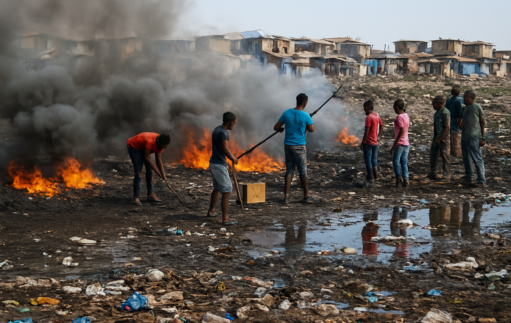
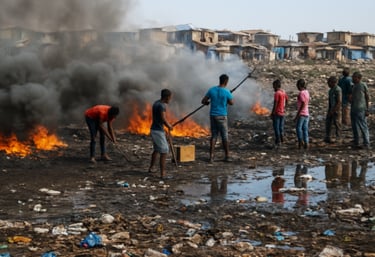
Source: United Nations : ‘’ Biodiversity loss: accelerating extinction rates trigger a domino effect: The biodiversity network is unraveling ! ‘’.
Source: World Wildlife Fund : ‘’ 73% of wild vertebrate populations have declined since 1970 ‘’.
Source Zoological Society of London: ‘’ Based on scientific data, the conclusions are edifying and even exceed predictions‘’.


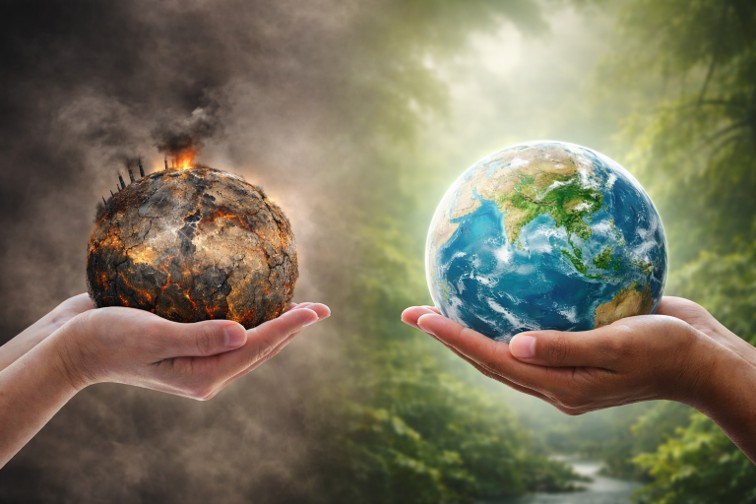
… where humankind must reinvent its balance with living things…
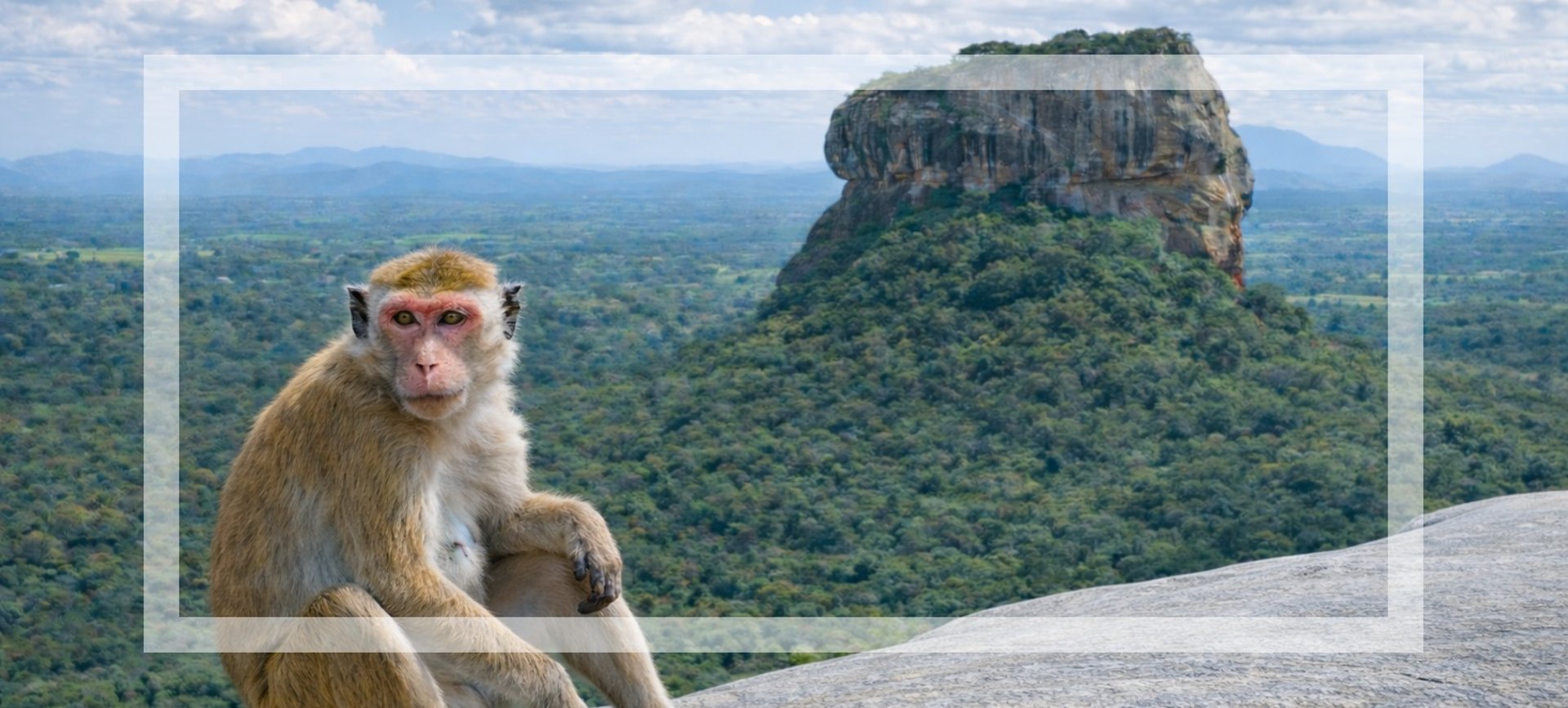
… Sri Lanka appears to be a unique natural laboratory, still preserved, on a human scale, that can still be protected :
Protecting Sri Lanka
means protecting a place where nature, animals, and humans are intimately connected,
and where every action, no matter how small, can still change the course of events.
An exceptional concentration of global biodiversity
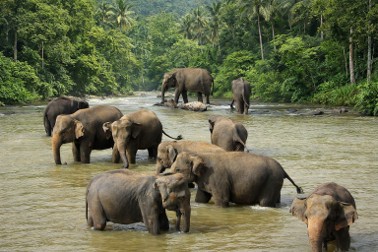
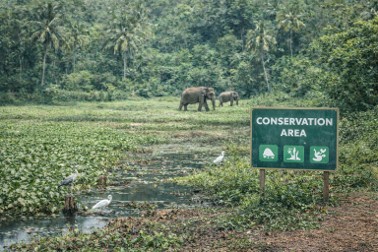
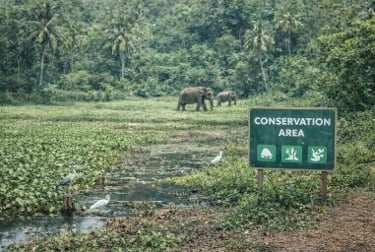
Elephants: invisible pillars of ecosystems
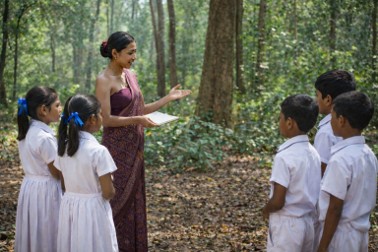
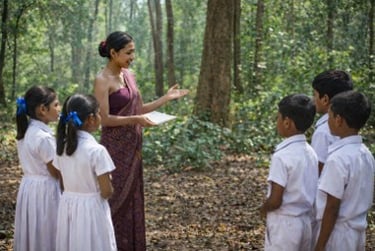
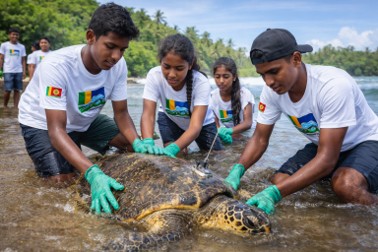
Young people: hope and responsibility for the future
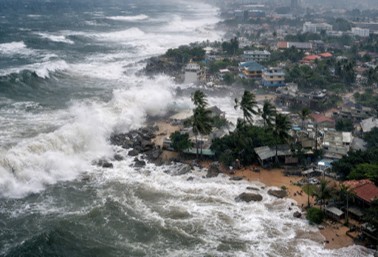
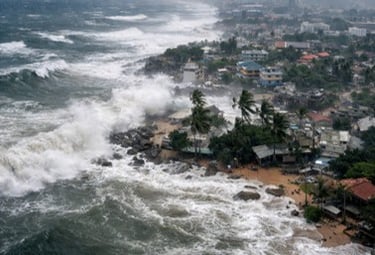
A country with little responsibility but highly exposed to climate change
Help that can still make a difference
Young people: the key to Sri Lanka's future... and perhaps ours too
A democracy on a human scale, based on harmony and the culture of life
In a world in crisis...






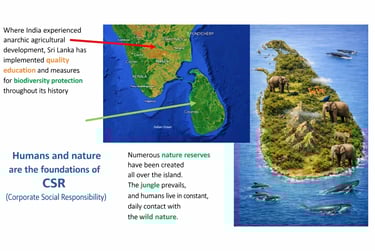


The Democratic Republic of Sri Lanka is an island covering 65,610 km², nestled in the heart of the Indian Ocean and renowned for the richness and preservation of its ecosystems.
It has a population of around 22 million, mainly from the Sinhalese community, whose history and traditions shape the country's identity.
When it gained independence in 1948, Sri Lanka refused to join the Indian Union, thus affirming its historical, cultural, and spiritual uniqueness deeply rooted in Buddhism, which still largely permeates society.
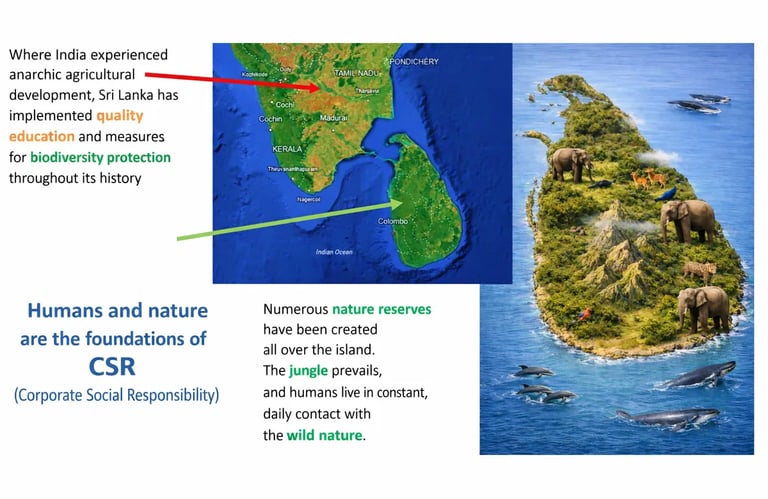
Despite limited economic resources, the Sri Lankan people have long maintained a close, respectful, and sustainable relationship with nature, which is considered an essential element of collective balance.


Sri Lanka is recognized as one of the planet's biodiversity hotspots.
Within a very small area, it is home to:
tropical forests,
wetlands,
coral reefs,
and iconic wildlife, including Asian elephants.
Protecting Sri Lanka means protecting an essential part of global biodiversity.




Elephants are not only endangered animals.
They play a fundamental role:
they shape landscapes,
disperse seeds,
and maintain the balance of forests.
Today, the coexistence between humans and elephants has become fragile:
loss of natural habitats,
growing conflicts,
human and animal suffering.
Helping Sri Lanka means seeking solutions for sustainable coexistence, not domination.


Children and young people today are growing up in a context marked by:
economic fragility,
increasingly visible climate change,
sometimes precarious access to education,
and uncertain food security.
Yet they represent Sri Lanka's greatest hope:
By giving them the intellectual tools to understand the issues at stake,
and raising their awareness of the richness and fragility of their biodiversity,
they can become enlightened guardians of an exceptional natural heritage.


Sri Lanka contributes very little to global greenhouse gas emissions,
but suffers greatly from the consequences:
floods,
droughts,
coastal erosion.
It is also a real issue of climate justice.
In many countries, international aid is diluted, institutionalised and sometimes dehumanised.
In Sri Lanka, targeted actions can still:
preserve specific ecosystems,
transform villages in a sustainable way,
protect endangered species,
and directly support local communities.
The impact there is concrete, measurable, and deeply human.




Investing in Sri Lanka's youth is the most powerful lever for preserving a natural environment that is still largely intact.
By giving young people the knowledge, tools and values they need, Sri Lanka can become a global benchmark for protecting life on Earth,
an inspiring model for future generations and for our planet.


FRANCE TO SRI LANKA works to protect the SRI LANKAN exception through its various initiatives :
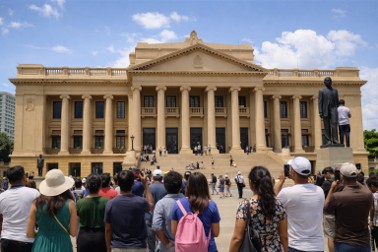


This harmony is based in particular on the importance placed on education, which is compulsory and free for all, girls and boys alike.
Schools thus play a fundamental role in transmitting the values of knowledge, respect, and responsibility towards living beings, helping to forge a society that is attentive to people and their environment.
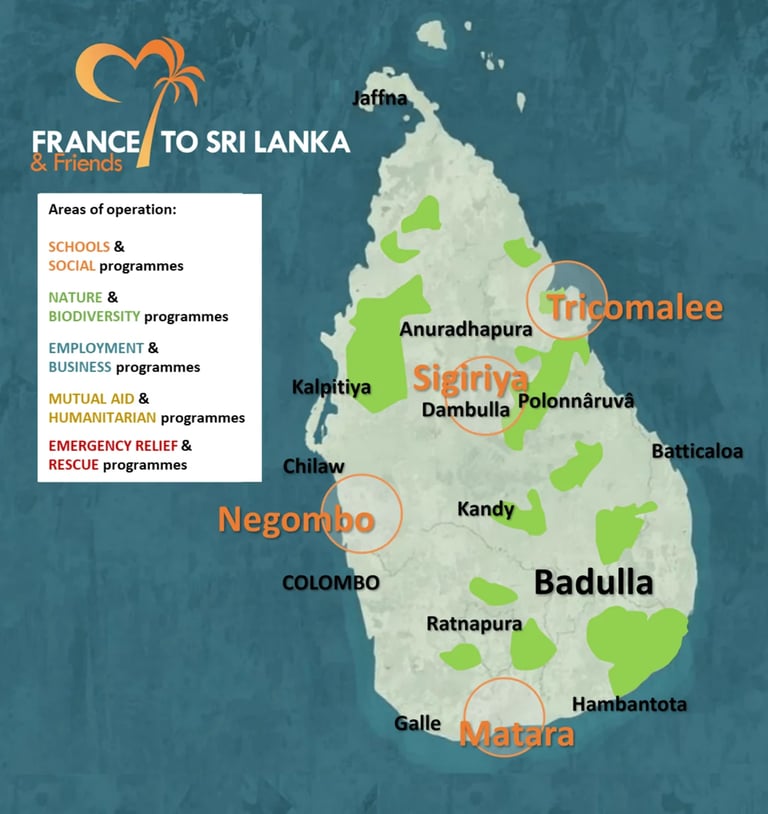
Areas of operation:
Contact :
FRANCE TO SRI LANKA
54 Montée des Ecureuils
73410 LA BIOLLE
SAVOIE - FRANCE
© 2025. All rights reserved.
FRANCE TO SRI LANKA et FRIENDS TO SRI LANKA sont des marques déposées.

Bank : CREDIT MUTUEL
Registration number in the national register of associations : W732011373
SIREN : 924 484 124 00012
Association recognized as being of general interest according to DGFIP ruling of February 6, 2024
Association eligible under the French “Coluche Law” (provisions of 1 ter. of Article 200 of the General Tax Code) allowing a tax reduction of 75% for donations up to €1,000 for individuals residing in France.
_________________________________________________________